Παρασκευή 26 Σεπτεμβρίου 2025


Τετάρτη 16 Ιουλίου 2025
St. Marina's contemporary miracle proving the invalidity of heretical baptism
Editors Note (update): Some find the saints words in this post as impossible and the idea gravely mistaken. However, this is not an isolated teaching. The Orthodox Church has taught much on this subject. For supporting evidence, a presentation of historical continuity, canonical analysis, other saints' testimony, and more information, see our book published through Uncut Mountain Press: On the Reception of the Heterodox into the Orthodox Church: The Patristic Consensus and Criteria.


Σάββατο 15 Ιουνίου 2024
Even the Pagans loved him

In the last years of Bishop Nicholas (Kasatkin)’s service in Japan, the attitude towards the Mission and the Japanese Orthodox Church became extremely respectful. Archpriest John Vostorgov, the future hieromartyr, who visited Japan in 1909, testified: "There was no person in Japan, after the emperor, who would have enjoyed such fame in the country as the head of the Russian Spiritual Mission. In the capital of Japan, there was no need to ask where the Russian Orthodox Mission was; it was enough to say one word 'Nikolai'... Even Orthodoxy itself was called by the name 'Nikolai'."
Even the pagans treated Saint Nicholas with great favour and sincere sympathy. One could often observe the following picture: a tall, heroically built Vladyka was walking along the streets of Tokyo with a swift step. Seeing him, the townspeople, complete strangers to him, greet him with noisy delight shouting: "Banzai Nikolai." And cute Japanese children surround him with a ring, rushing headlong towards him, like butterflies to a fire.
...At the end of 1897, to the great joy of Bishop Nicholas, two people finally arrived from Russia to Japan at once — Archimandrite Sergius (Stragorodsky) and Hieromonk Andronik (Nikolsky).
On December 31, Saint Nicholas writes in his diary: This ends the old year. It gave the Mission two missionaries: Father Archimandrite Sergius and Father Andronik. The people seem to be exactly the ones I have prayed for, for whom I have always waited: ones looking only at the matter at hand, and looking simply, clearly, humbly and maturely. There are no stilts, nor the slightest idealism that threatens disappointment, is noticeable at them. ...God give! God give! They should grow, I would pray."
About his arrival at the Mission and meeting Bishop Nicholas, Father Andronik (the future Archbishop of Perm, hieromartyr) left valuable notes in his diary that vividly characterize the Vladyka: "The Most Reverend Nicholas was very happy about our arrival and, due to his generally lively character, immediately spoke to us. <...> He immediately led us throughout the Mission, taking us to church, to the library, and so on. And all this quickly — on a run. In general, the Vladyka is very lively, as if he was still a very young man, zealous and energetic, in the age of 27–30, while he is already 62 years old. <...> The Bishop himself is in charge of the entire Mission, he understands everything, knows everything... And how does he have enough energy and time for everything?! He is all about embodied energy and keen interest in everything. And he speaks about everything vividly, with enthusiasm, as if it were his own native business, and most importantly, his word and view of everything are filled with the most living, integral faith in the cause and in the Orthodox Church as the only true custodian of the gift of Christ's Gospel. 'We,' says the Vladyka, 'are servants of the Mother Church, the only true one, and it is our holy duty to loudly and incessantly proclaim the truth of Christ.'"
Alas, the arriving assistants worked at the Mission for just over a year — in 1899 both left Japan: Archimandrite Sergius received another assignment, and Hieromonk Andronik became seriously ill. It is interesting that, as if foreseeing this in advance, Father Andronik wrote in his diary almost immediately upon his arrival in Japan: "And I feel sorry for him, poor creature: as if he always alone and was, and is, and will be, and we are all somehow temporary workers being constantly ready to run away, either by quarreling with him or by falling ill."
Missionaries arriving from Russia could not withstand the difficulties of mastering the Japanese language, miserable working conditions, difficult humid climate, and unusual features of local life. They were overwhelmed by an irresistible longing for their homeland, called nostalgia, driving others to the point of insanity.
Having no reliable assistants, the Bishop carried out all the affairs on himself: he was in charge of the Mission, was the director of all its theological schools, and he himself taught a number of disciplines in them, performed divine services, preached, toured parishes scattered throughout the country, did translations, wrote scientific works, edited magazine articles and so on and so forth. And he managed to do it! Things in the Mission were steadily going uphill.
In 1896, Bishop Nicholas wrote to the Holy Synod about the state of affairs in comparison with foreign missions. If the Catholics, with 205 members of the mission, have a Japanese flock of 52 thousand Christians, the Protestants, with 680 missionaries, have 38 thousand, then the Orthodox, with one missionary, have 23 thousand Christians.
At the same time, the Vladyka was by no means inclined to attribute the successes of the Mission to himself. "What is the reason for the success of the Mission?" he said. "The reason is the sincerity of Orthodoxy and in God's help. The Lord favours His young planting of the Orthodox Church among the Japanese people. And in granting its success He shows undeniable signs of His favour."
Asthma scratched the head's back and calmed down
At the end of 1911, Bishop Nicholas became seriously ill. He was choked by asthma, at night he suffocated and could not sleep. Bishop Sergius (Tikhomirov) observed with contrition what severe physical suffering the sick Vladyka had to endure. But even now the saint did not allow himself to become despondent and often resorted to saving humour. Once, for example, he wrote to His Eminence Sergius, who was away, the following: "My asthma asked me twice: 'What, shouldn't we sing a funeral service With the saints?' But I answered it: 'It's impossible: and Subdeacon Kawamura is not here, he left to repair the leaking roof, and the Right Reverend is not there.' It scratched the head's back and calmed down."
For everyone who knew and loved the bishop, days of sadness and sorrowful forebodings came. Bishop Sergius, having escorted the saint to the hospital, wrote in his diary: "Vladyka left, as if the red sun had gone away. Everyone walks cloudy, like on an autumn day in St. Petersburg."
Knowing that he was dying, the head of the Japanese Orthodox Church once said to his successor: "Our role is no higher than a plough. So the peasant ploughed, the plough wore out, and he threw it away. I'm worn out too. And they'll throw me away. The new plough will begin to plough. So look, plough! Plough honestly! Plough tirelessly! Let God's work grow!" He paused thoughtfully and added: "Still, it's nice that it was God Who ploughed by you. That means you haven't rusted either. This means that by working in God's field, your soul has also become somewhat purified, and for this we will always thank God."
In those sad days, he once said thoughtfully: "Oh, really, it's very interesting what and how it is there in heaven... I'll soon find out everything. And in this regard, I'm much happier than you."
Δευτέρα 23 Ιανουαρίου 2023
Τρίτη 9 Αυγούστου 2022
Παρασκευή 6 Μαΐου 2022
APOSTASY

Apostasy is permitted by God – do not attempt to stop it with your powerless hand. Flee from it yourself, protect yourself from it; that is enough for you to do. Learn to know the spirit of the age, study it, so whenever possible you will be able to avoid its influence…Only God’s special mercy is able to stop this all-destroying moral epidemic, to stop it for a while, because it is necessary that everything foretold by the Scriptures happen.
Judging by the spirit of the times and the intellectual ferment, one must suppose that the structure of the Church, which has been shaking for some time, will fall quickly and horribly. There is no one to stop and oppose it. The measures undertaken to support it are borrowed and hasten its fall, rather than stopping it. There is no one who can be expected to restore Christianity!
The vessels of the Holy Spirit have finally dried up everywhere, even in the monasteries, those treasures of piety and grace…The salt has lost its savor.
In the chief pastors of the Church there remains only a weak, dim, inconsistent and incorrect understanding according to the “letter” which kills the spiritual life in Christian society and destroys Christianity, which is an action, not a letter. It is distressing to see to whom the sheep of Christ have been entrusted, to whom their direction and salvation have been committed. But this has been permitted by God…
God’s merciful patience delays and postpones the decisive disintegration for the small remnant of those being saved, while those who are decaying or have decayed attain the fullness of their corruption.
Those who are being saved must understand this and make use of the time given them for salvation. May the merciful Lord shield the remnant of those who believe in Him! But, this remnant is meager and is becoming more and more so…Let him who is being saved save his soul
By St Ignatius Brianchaninov, (Vol. IV and the Patericon)
Τρίτη 15 Φεβρουαρίου 2022
Παρασκευή 20 Αυγούστου 2021
Sergius (Tikhomirov) of Japan
Metropolitan Sergius (Tikhomirov) of Japan (1871-1945) was sent to Japan by the Church of Russia as the assistant to and successor to St. Nicholas of Japan as the ruling bishop of the Japanese Orthodox Church.

He was born Georgy Alexeevich Tikhomirov (Георгий Алексеевич Тихомиров) on June 3, 1871 (OS) in the village of Guzh near Novgorod, Russia into the family of a rural priest. His father, Alexei, was a popular and famous priest in the area. Georgy did well in elementary school and after graduation entered the St. Petersburg Theological Academy, graduating in 1896. Upon graduation he continued at the Academy teaching theology. During his time at the St. Petersburg Academy he was noted as a prolific preacher and author of many works on Church history in the Novgorod region.
Prior to his graduation from the Academy he took monastic vows on September 7, 1895, taking the monastic name Sergius. Then, on December 2, 1895, he was ordained a deacon in the Isakievskii Cathedral in St. Petersburg, and two days later he was ordained a priest. He was subsequently appointed inspector at the Academy. In December 1899, Father Sergius was raised to the dignity of archimandrite and was named Rector of the Academy. On October 8, 1905, Archimandrite Sergius was awarded his Doctor of Theology degree. Then, one month later he was elevated to the episcopacy, being consecrated Bishop of Iamburg and vicar to the archbishop of St. Petersburg. He was 35 years old, an uncommonly young age at the time for entry into the episcopacy.
In 1908, Sergius was assigned to be the assistant of Abp. Nicholas of Japan and his eventual successor. He arrived in Japan on June 27, 1908 as the bishop of Kyoto. Already proficient in a number of languages, including Greek, Hebrew, German, Latin, English, German, Arabic, and the Slavic languages, Bishop Sergius immediately began to get acquainted with Japan and its culture and language, and within a year he began preaching Orthodox Christianity among the Japanese people.
Since all previous assistants sent to Japan to help Abp. Nicholas returned to Russia, the latter asked Sergius if he intended to remain in Japan permanently or to return in a few years as those earlier had. Sergius affirmed that he had come dedicating himself to remain for the rest of his life. Over the next few years Sergius involved himself deeply in the church and mission and gradually assumed management of the organization, allowing Nicholas to devote his time to the seminary and his extensive translation work. Sergius engrossed himself particularly in missionary efforts, visiting widely, from the southern part of Sakhalin that Japan had gained from Russia after the Russo-Japanese war, to Kuril Islands and Manchuria.
Sergius was at Nicholas's side during the last years of his life, and after Nicholas's death in February 1912, Sergius was named in May 1912 the new ruling bishop of the Orthodox Church of Japan as Archbishop of Japan. Well familiar with Nicholas's missionary work, the new archbishop continued Nicholas's steps including publication of theological books through the Tokyo Seminary.


Δευτέρα 12 Οκτωβρίου 2020
THE IRISH CHURCH IN THE EIGHTH CENTURY
Archpriest Vladislav Tsypin

An ancient Irish monastery
As in the previous century, one of the main centers of Christianity and culture in Western Europe in the eighth century was Ireland with its relatively small population, which numbered around 250,000 at most.
Irish monks enjoyed indisputable authority among the people. One of its characteristic examples was the declaration of the “laws of the saints”, which were instituted in monasteries and then adopted by the rulers of the numerous kingdoms Ireland was divided into. The first such law was introduced in 697 by St. Adomnan, Abbot of Iona, and became known as “the Law of Adomnan” (“Cain Adomnain”), or “the Law of the Innocents.” It prohibited the killing of women, clerics and children who did not take part in warfare (that is, noncombatants, to put it in modern terms) and perpetrators were exposed to substantial fines. In 734, “St. Patrick’s Law” was enacted, and in 788 “St. Ciaran’s Law” was proclaimed.
“When the laws were promulgated and amended, the heads of church communities would travel all over regions of Ireland with relics… They would receive gifts from rulers and distribute alms.”1
Saints’ remains were venerated by people as great relics. In 727, a conflict between two clans flared up in Ireland. Hoping that through the prayers of St. Adomnan a truce could be reached, the monks from Iona Monastery brought the saint’s relics to Ireland and visited forty churches that belonged to Iona. And indeed, it became possible to reach a truce very soon. Many people took an oath on the holy abbot’s relics and promised to obey “The Law of Adomnan”,2 who discouraged enmity between people.
In the second half of the eighth century there appeared an ascetic movement that aimed to cleanse Church life in Ireland from numerous abuses. For example, rivalry between the supporters of different monasteries would often result in scuffles and bloody clashes. One of them took place in 764 and turned into a real battle—as a result about 200 people were killed because of false religious zeal. The leading figures of that ascetic movement, such as St. Maelruain, Dublitir and other bishops and abbots, called themselves “Celi De”, or “Culdees”, which can be translated as “worshippers (sometimes “servants”, “companions”) of God”.
St. Maelruain is venerated as the founder and first abbot of Tallaght Monastery near what is now Dublin. He was tonsured at the monastery of St. Ruadan of Lothra. In 774, he obtained lands in Tallaght from the King of Leinster to establish a monastery there and brought the relics of holy martyrs to it. Some Lives call him “bishop of Tallaght”, though there is no solid evidence confirming the existence of a diocese there. St. Maelruain used to say that the three most profitable things for monks throughout the day should be “prayer, manual labor, and study”. During the day they will obtain much profit from reading, writing, and sewing clothes. The rule of St. Maelruain, based on the instructions of the Egyptian desert fathers through St. John Cassian, devotes much attention to fasting, praying and repentance to one’s confessor, whom the Celts called “the soul friend.”3 This rule was also introduced in other Irish monasteries that joined the Culdee movement. The purpose of the rule was to return to older forms of ascetic life in Ireland. Special attention was given to genuflexion and prostration in prayer, the mortification of the flesh and such strict practices as prayer in cold water with arms raised up in the form of the cross, and full abstinence of alcoholic drink… St. Maelruain’s followers, the Culdees, also forbade the practices of “pilgrimage”, or “wandering for Christ” so characteristic of Celts—as well as moving from one monastery to another, sea voyages and settling abroad.4 St. Maelruain reposed in the Lord in 792.
St. Oengus honored and appreciated St. Maelruain, his beloved mentor and teacher, so much that he called him “the great sun of the south plain of Meath”.5 St. Oengus himself composed martyrologies in verse and prose, and the Stowe Missal (containing unique recordings of ancient Irish liturgical texts).6 The Culdee movement attached great importance to Christian education and the enlightenment of the people—monks in particular—producing some of the most educated Western theologians and thinkers of the age. Culdee communities attracted pious laypeople as well. Some groups of laypeople started to form their own small communities. They were like villages, situated in wild, remote areas, and people lived there in piety together with their families, practicing farming and manual work, often praying and singing spiritual hymns (in addition to the participation in Church prayer and the sacraments).

Learned Irish monks generously shared the fruits of their Christian and classical education with people from the Continent; they were sought after at the court of Charlemagne and other Western monarchs. A network of Irish monasteries founded by the Gael missionaries covered the whole Continent. In the eighth century, monasteries inside Ireland were at a high level of contemporary Western Christian culture. Some of the most brilliant examples were book miniatures, remarkable for their striking originality because (unlike Continental ones) they were not influenced by tradition of Late Antiquity. Their distinctive characteristic is the domination of ornamentalism over figurative pictorialism: “A combination of the abstract geometry of the Celts (various spirals and twists) and motifs of the Anglo-Saxon animal style is characteristic of the décor of Irish manuscripts.”7 Another peculiarity of Irish miniatures is their brilliance, the use of bright, pure colors, separated by a strong, sharp-cut outline. Irish artists who illuminated manuscripts would avoid leaving any blank space and cover the whole leaf with a colorful ornament. Figurative motifs are little developed, complying with the decorative message and fitting into the ornament, so the image is always two-dimensional. Most eighth-century Irish illuminated manuscripts are the Four Gospels. Among the most celebrated manuscripts of the age is the Book of Kells, which contains the Four Gospels, and is kept at Trinity College in Dublin. It dates back to the late eighth or the early ninth century. Irish scribes developed a distinct style of calligraphy, based on a synthesis of Roman half-uncial and elements of the Greek practice of writing letters. This easily recognizable script became known as “insular”, and it greatly influenced Anglo-Saxon calligraphy. In some manuscripts, Irish scribes used Greek letters to write Latin texts. Another attribute of early Irish Christians is the reverence with which they held spiritual books. Books were venerated as relics and miraculous properties were attributed to them. According to Svetlana Kovalevskaya:
“Most manuscripts survive in poor condition because they were used for healing people and animals, and even were taken to battles.”8
The Celtic art of the jeweler, of the metalworker and of stone carvers (both insular and Continental) had been known for their high level of perfection since the La Tene Culture. The achievements of ancient craftsmen in art were inherited by Irish jewelers, metalworkers and blacksmiths of the Christian era. The finest workpieces of the eighth century were commissioned by the Church. Liturgical vessels and other items for church use were made of gold, silver, bronze, tin; they were decorated by inserts of multicolored enamel or glass, filigree, carving and engraving. The majority of the surviving items are reliquaries. A notable example of jewel art is the eighth-century reliquary that was found in Rannaghan—it has images of the Savior in a tunic, angels and martyred soldiers, whose garments are covered with intricate ornaments.
Almost all of the Christian churches in Ireland in the first millennium A.D. were wooden (mainly oak, a short-lived material). No traces of those buildings have survived to this day, and we can above all judge the country’s early Christian architecture by book miniatures. These were “rectangular buildings with protruding corner beams, a high, gabled double-pitched roof with a carved ridge… Beams were placed vertically.”9 The altar in such churches was separated from the nave, with partitions separating the male and the female parts of the church space. Doors and doorways were adorned with carvings, walls and partitions were covered with sacred images and ornaments. The earliest records of stone churches (of which none are preserved) go back to the eighth century. Such temples were a rare exception at that time. Why stone buildings appeared so late on the island (which is replete with stone, though, unlike Russia, has a scarcity of forests) is unknown. There have been various attempts to explain this phenomenon.
“Some researchers conjecture that the pre-Christian oak worship and the reverence to the first wooden churches originally founded by saints were revealed in this way.”10
In the late eighth century, Ireland, like continental Europe, suffered a disaster that continued for several centuries and changed the course of its history radically. These were raids of the Norsemen. In 794, Vikings ravaged settlements on small islands between Britain and Ireland. During those assaults Irish monasteries were looted and their monks massacred. Those forays were followed by new plundering raids by Scandinavians who would disembark from their longships on the coast. In the early ninth century, the Norsemen would attack the settlements of Eire from the shores, and later would move upstream on their drakkars further inland, where they would murder people, steal treasures, burn the local dwellings, churches, monastic and buildings, and take locals captive or enslave them. Assaults were made once a year. The Irish tried to resist and indeed managed to beat off some attacks, but in most cases they suffered defeats from the aggressive and ruthless invaders. Besides, their political fragmentation made the nation very vulnerable. Describing the situation in Ireland in the early ninth century, a chronicler from Ulster wrote:
“There was no bay, no harbor, no fortification, no shelter, no burgh that was not flooded with Vikings or pirates.”11
Having consolidated their positions on the coast, Vikings settled and overwintered there. Later their settlements appeared further inland, or at a distance that could be covered in a day and then deep inland. Now the threat of annihilation and enslavement was a real danger to the Gaels of Ireland—something that the Britons had gone through several centuries before [at the hands of Angles, Saxons, and Jutes.—Ed.] and had only managed to retain independence in the west of their motherland—in Wales.
The political and national catastrophe that had befallen Ireland didn’t strangle it spiritually. Its missionaries’ religious zeal of didn’t fade away, and the country continued to produce saints.
Archpriest Vladislav Tsypin
Translated by Dmitry Lapa
Pravoslavie.ru
10/12/2020
1 Nina Zhivlova. Ireland. The Orthodox Encyclopedia (the Russian edition). Vol. 26. P. 540.
2 D. Lapa, V. Derzhavina. Lives of the Saints Who Shone Forth in the Lands of Britain and Ireland (the Russian edition). published by the Diocese of Sourozh, London, 2012. Pp. 412-413.
3 Ibid. P. 530.
4 Ibid.
5 Ibid. P. 531.
6 Ibid. P. 530.
7 Nina Zhivlova. Ireland. The Orthodox Encyclopedia. Vol. 26. P. 605.
8 Ibid.
9 Ibid. P. 592.
10 Ibid.
11 Aaron Gurevich. The Viking Raids. Moscow, 1966. Pp.82-83.
Τρίτη 31 Μαρτίου 2020
Father Seraphim Rose: Strength in Christ

“So that we will not forget Him and His eternal Kingdom, God mercifully sends us troubles, distress, sorrows, persecution; these are to awaken us who sleep and show us where our true home is. Let us remember the example of the Holy Apostles, and especially the burning fervor and faith which sustained them in all their trials; let us heed the many exhortations of the Apostle Paul, as well as those of our shepherds today who continue to speak and tell us to prepare, in pain and tribulation, for the Kingdom of eternal glory and joy. Weak as we are, no trial is too great for us if our strength is of Christ. “I am persuaded that neither death, nor life, nor angels, nor principalities, nor powers, nor things present, nor things to come, nor height, nor depth, nor any other creature, shall be able to separate us from the love of God, which is in Christ Jesus our Lord” (Rom 8:38-39)” – Father Seraphim Rose
Source
Τρίτη 17 Μαρτίου 2020
Δευτέρα 18 Νοεμβρίου 2019
THE NATIVITY OF CHRIST IN ORTHODOX JAPAN
The young Hieromonk Nicholas (Kasatkin), who was appointed rector of this church in place of an elderly priest, Fr. Vasily Makhov, came to Japan in the summer of 1861. In his new motherland the future missionary, following the chronology of events in the Gospel, first of all celebrated the Nativity of 1861/1862, and then, the Radiant Resurrection of Christ. Nativity church services were always particularly solemn in Japan, on a par with Paschal ones.

A Nativity service in Handa.


Δευτέρα 2 Σεπτεμβρίου 2019

Τετάρτη 14 Αυγούστου 2019
The Saint, the Priest, and Face-tattoos

By Fr Photios Parks
Some years back, there was a point in my life when I didn’t give a second thought to the Saints. I really didn’t see how they had any place within my faith. In Bible College and in Protestant seminary, I was fed the idea that saints were either a type of good luck charm to sell my house, a statue in your yard to attract birds, or they were individuals likened to magicians whose bones were exploited in medieval times. Fortunately, I had a life-changing experience that dispelled my incorrect notions about Saints and changed my whole paradigm in the way I view these holy servants. I now can’t imagine myself living my life without their guidance and assistance.
There was a time in my life where I was a director of a large Protestant homeless shelter in a major Northeastern city. In that director role, I was responsible for the physical and spiritual wellbeing of thirty-men that were recently released from prison or who had been homeless on the streets. One thing I noticed as I ministered to these men is that I kept hearing a similar story about the churches that they attended. They would go to churches where their charismatic preachers would tell them something like: “If you tithe to our church, God will bless you abundantly.” This is a common theological mark of the health and wealth/prosperity-movement within some Protestant circles. Many of these formerly homeless men would offer all the money they had to that pastor in order to receive the promised blessings. Sadly, those blessings of wealth, health, and all their desires never came to fruition for those men. Instead, the men’s lives would continue to cycle through immense poverty and hardship.
I found myself wanting to prove to these spiritually manipulated men within our program that not all churches operated with this prosperity-gospel technique. I came up with the idea to take “fieldtrips” to local churches so that they could meet different church leaders and see different types of church traditions that differed from those over-promising pastors. On these church fieldtrips, the group of gentleman was able to see one of the first AME churches, Reformed churches, main-line churches, and hipster churches. The group of men asked plenty of inquiring questions and got to take wonderful church tours.
One of the last churches in the area that we visited was a large, Greek Orthodox Church. Up to that point, I myself had almost no familiarity with Orthodoxy and so as we ventured to this odd-looking church with Greek inscriptions on the outside of its church building, I had no idea what to expect.
The Orthodox Priest, dressed in his cassock, graciously welcomed our group at the door. As we entered into the narthex of the church, we were welcomed into the space by a beautiful picture resting on an ornate stand. Emblazoned in gold and jewels, the icon depicted a female saint. One of the men in our group blurted out at the sight of the icon, “why do you have graven images?” He clearly was leaning on his understanding of the Old Testament and saw this icon as a type of graven image and an offence to God.
Hearing this question, in a patient and kind way, the priest explained that on this particular day, the Orthodox Churches celebrates the Saint Agatha. The Priest then began to describe to our group Saint Agatha’s life.1 He stated that Saint Agatha lived in Italy in the third century and that she was a follower of Christ. Agatha was a beautiful young woman, whom many men wanted to marry. But Agatha, as a follower of Christ, wanted to retain her holiness and to live set apart for the sake of her Savior and chose to not marry. A wealthy pagan by the name of Quintianus, captivated by Agatha’s beauty, asked for her hand in marriage. Agatha denied Quintianus’ advancements and declared to him that she wanted to remain a virgin for the entirety of her life. Quintianus, enraged by Agatha’s rebuke, first proceeded to parade Agatha into the town center and with the townspeople watching, Quintianus had his servants cut-off Agatha’s breasts. Quintianus, again asked a final time for Agatha’s hand in marriage, as if the previous inhumane mutilation could compel someone toward marriage, and again Agatha rebuked him and pledged herself to Christ and to holiness. Again, fueled by rage, Quintianus as a last final act to exploit Agatha’s desire for purity, had her stripped bare in front of all of the town’s onlookers and then had her dragged to her death tied behind a horse-drawn carriage.
As the Priest told us this dramatic story, I noticed out of the side of my eye, one of the gentlemen in the group was acting a bit strange. He was sort of pacing around, clenching his fists, and mumbling under his breath. He looked as if he was teetering the line between anger and crying. I hadn’t really known this particular man, who we will call “Shawn,” as he was new to the group and to our program. Shawn was visually intimidating as he stood 6 foot 3 inches, had intense eyes, and tattoos all over his face. He looked similar to the giant man on the movie The Green Mile, but scarier.
My mind was racing as I began noticing this gigantic man become more and more frustrated. Bad scenarios played out in my head: Was he going to knockout this kind, old priest? Was he going to breakdown in tears? Heaven forbid—would he try to damage the icon of Saint Agatha? I decided, hesitantly, to go over and speak with Shawn to attempt to calm him down. Having not yet established trust with Shawn, I tried my best to be sympathetic to the large, pacing man.
I said to him, “Shawn, what’s going on man? I can tell you’re frustrated…is there anything I can do for you right now?”
Still pacing, clinching his fist and with tears in his eyes, he angrily said to me, “Why would they do this?”
“I don’t know Shawn, pictures aren’t a part of my tradition,” I answered him assuming he was talking about the icon.
He shrugged off my answer, “No, why would they make her a saint?”
Again, winging it: “I don’t know Shawn, I don’t fully understand the saint thing.”
He replied, crying at this point, “Why would they make her an example?”
“I don’t know, Shawn” is all that I could come up with. Shawn didn’t punch the priest or turnover the icon.
I met with Shawn the following day to debrief the situation, as I wanted to figure out what had happened the previous day. Shawn broke down that day in my office. He explained to me how his mom had been raped as a teenager and that her pregnancy with Shawn was the result of that rape. He described to me in graphic detail how almost everyday his mother reminded him that he was the result of rape and she routinely punished him for it. Shawn then described how as a result of all the pain he felt in his life, and all the mistreatment he had received, he too proceeded to hurt others throughout his life.
He then explained to me that in hearing Saint Agatha’s story it was unimaginable how someone like that, someone abused so harshly, could be an example for the Christian faith. It was even more puzzling to Shawn that someone like Agatha could be considered a saint. He was awestruck at how God and a Church could look at someone so damaged, so broken, and declare that someone like Agatha is holy.
Shawn saw himself in Saint Agatha’s life. He saw in her life a guide for his own. He saw in her hope for his own torture. He had found a Savior who did not deem him cursed or too broken for salvation. He had found a Church that gave him the opportunity, even with all of his shame and brokenness, to become something beyond his shortcomings. He began the process of recognizing that within Christ there was hope for him to become holy and to even to become an example of the faith for others. There was a place and purpose within his life and that all of the pain he experienced could be a part of his turning toward holiness. Shawn joined that Orthodox Church. Seeing a 6’3’’ African-American man with face-tattoos standing amongst Greek yia-yias at a Greek-festival laughing together and sharing jokes was like catching a small glimpse of heaven.
Saint Agatha is recognized as a Saint within the Eastern and Oriental Orthodox, Catholic, and Anglican traditions. She is just one of thousands of shining beacons of holiness in the church’s history of raising up holy and set apart disciples of Christ. Saints aren’t vessels to help us find lost items as I had previously thought. Saints exist to be vessels for us as tangible witnesses that the places of loss within our own hearts do not define who we truly are. Rather, the fact that Christ sees all of us as bearing the image of God is the foundation for us to continue to pursue Christ and the holiness that stems from being within his fold.
Saint Augustine once wrote, “There is no saint without a past, no sinner without a future.” For people like Shawn, and myself, the saints show us by their examples that we are destined for greatness as even the most shameful moments we experience in our life are merely part of the journey of transformation within the theosis process as we are becoming holy like God is holy. Saints are alive in Christ, but they lived as holy humans when they were on earth. Because of their holiness, saints like Agatha fully understand the challenges and triumphs that we experience in our lives and because they know our hearts, we can look to them as guides and beacons for our own lives, and we can graciously ask for their prayers as they worship Christ in paradise.
Saint Agatha and all the Saints pray to God for us!

From the Introduction of the forthcoming book:
“Holiness in the Hardship: Saints of Strength for Common Folks” by Fr Photios
1. This is only one account of the life of Saint Agatha.
Source
Πέμπτη 8 Αυγούστου 2019
Elisabeth Feodorovna | Revealing the Depths of a Noble Heart (video)
Πέμπτη 30 Μαΐου 2019
Orthodox Popes of Rome: Have You Ever Heard about Them?
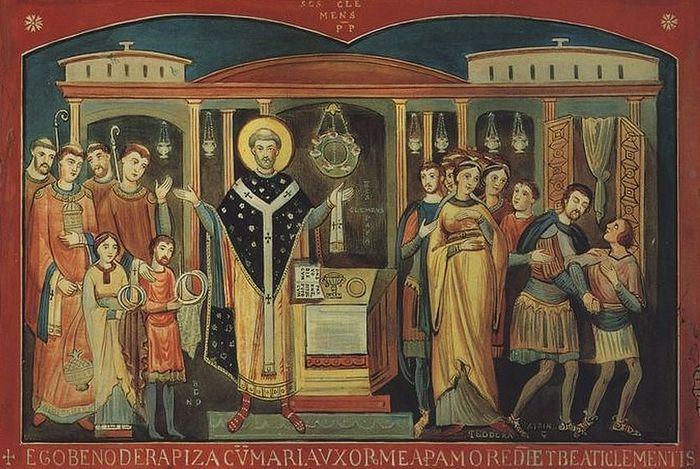
The Holy Church of Rome, founded by Holy Apostles Peter and Paul, was exceedingly ardent and faithful to the tenets of the apostolic faith for one thousand years. “How happy this Church is!” Tertullian († 220/240) exclaims. “This Church is the Church upon which the apostles poured all doctrine with their blood.” (De Prescr.) We Orthodox Christians tend to forget that Popes of Rome did a lot to promote Orthodoxy both in the West and the East, especially in the periods when the East was beleaguered by numerous heresies and schisms. This post will remind you of the most notable Popes of Rome and their contributions to the Church.
Linus (†76). According to Irenaeus, it was Linus who was put in charge of the Church of Rome by the apostles not long before their martyrdom. He was Apostle Paul’s co-worker and the first bishop of Rome.
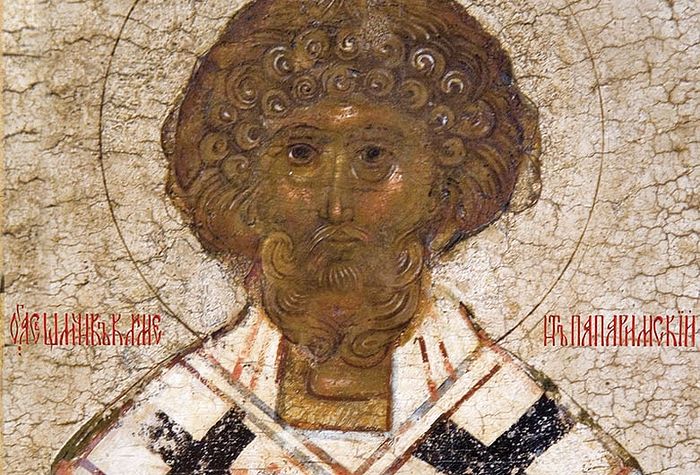
Holy Martyr Clement, Pope of Rome (†97). He was Greek. St. Clement is said to have been made bishop by Apostle Peter. He is mentioned by Apostle Paul. He wrote a well-known Epistle to Corinthians, encouraging peace and harmony in the Church. His epistle was read in churches along with epistles of holy apostles. He was exiled to Crimean quarries and then tied to an anchor and drowned in the sea.
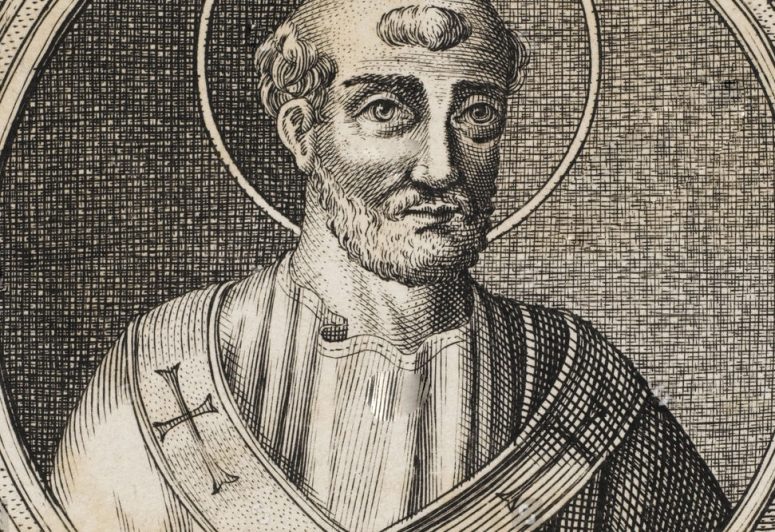
Telesphorus (†136). He had been a hermit in Palestine before becoming the bishop of Rome. He fought Gnosticism as the pope. It was him who first started celebrating Liturgy at night. His martyrdom occurred during the reign of Emperor Antoninus Pius.
St. Hippolytus of Rome (†235). He was a strong opponent of antitrinitarian heresies and a very conservative thinker. He suspected that Pope Zephyrinus was a heretic and seceded into a schism. He was in a schism for a long time. He reconciled with Pope Pontian when both of them were exiled to Sardinia. Pope Hippolytus was quartered and washed the sin of schism away with his own blood. An important source about the life of the Roman Church in the 3rd century titled Apostolic Tradition is attributed to him.
Liberius the Confessor (†366). A staunch champion of Orthodoxy in the wake of the Arian heresy. He was deposed by the emperor for his refusal to condemn Athanasius the Great and exiled to Thrace. Under threat of death, it seems he may have temporarily relented, or been set up to appear to have relented and signed a semi-Arian dogmatic formula, which could still be interpreted in an Orthodox way. As soon as he returned from the exile, he continued to fight Arianism. He built the Basilica di Santa Maria Maggiore after the Mother of God appeared to him in a dream and ordered him to build a church in the place covered with snow on a summer morning.
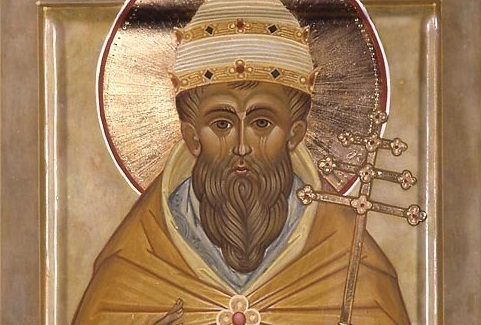
Leo the Great (†461). He was one of the most prominent popes. His everlasting importance is due to the fact that it was his dogmatic definition that became the official formula adopted by the Chalcedon Council, which promulgated the Orthodox teaching on the two natures in Christ. Leo is also known for rescuing the Empire by persuading Attila the Hun to turn back from his invasion of Italy.
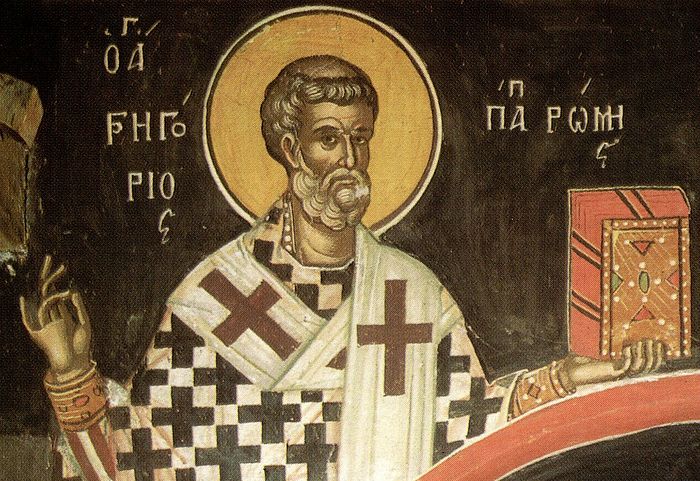
Gregory the Great, or the Dialogist (†604). He was a Roman senator’s son. He was very fond of Saint Benedict of Nursia so he decided to turn his manors into monasteries and became a monk. Later, he had to perform duties of the papal nuncio to Constantinople for a number of years. He was elected the new successor to the See of Peter at a difficult time. He helped the poor, often inviting them to his meals. It was thanks to his missionary outreach that pagan Anglo-Saxons began converting to Christianity. It was him who started referring to himself and the servant of servants of God. The famous Gregorian chant was his contribution to the worship of the Roman Church.
There is a long list of other Orthodox Popes of Rome, whose names all Christians should know. Although the East has objected to abuse of papal power, it has always acknowledged and respected the special place of the See of Rome in the Catholic Church. As Saint Symeon of Thessalonica (15th century) aptly puts it, “When the Latins say that the bishop of Rome is first, there is no need to contradict them, since this can do no harm to the Church. They must only show that he has the same faith as Peter and his successors… and that he possesses all that came from Peter, then he will be the first, the chief and head of all, the supreme high priest… That the Bishop of Rome profess only the faith of Silvester, Agatho, Leo, Liberius, Martin, and Gregory, we would proclaim him first among all other high priests, and we will submit to him not simply as to Peter but as to the Savior Himself.” (Dial. contra haereses, 23 // PG 155,120AC).
Let us honor the memory of holy Popes of Rome who remained faithful to the Orthodox Church, against which the gates of hell will never prevail.
Source
Τετάρτη 15 Μαΐου 2019
Akathist Hymn for St Nicholas of Japan
Kontakion 1
Chosen from the people of Russia to bear the glad tidings of Christ to the land if Japan, you laid down thy life for your fathers, strengthening them in the true faith.
Revering your deeds, we praise you thus:
Rejoice, O Nicholas, equal to the apostles, defender of the Church of Japan!

Ekos 1
An angel accompanied you, like Tobias of old, when in your youth you directed your steps to this remote land. Therefore we cry unto you thus:
Rejoice, glorious child of the land of Smolensk!
Rejoice, you who loved the Church from your infancy!
Rejoice, you who were not abandoned by the Mother of God in your orphanhood!
Rejoice, you who grew wise in spiritual wisdom!
Rejoice, you who foreknew your path at an all-night vigil!
Rejoice, you who defied worldly delights
Rejoice, you who were made worthy of both monkhood and priesthood!
Rejoice, you who craved for preaching the Gospel!
Rejoice, you who were full of compassion for those ignorant of salvation!
Rejoice, you who loved people far equally to those near!
Rejoice, you who did not fear persecutions!
Rejoice, O Nicholas, equal to the apostles, defender of the Church of Japan!

Kontakion 2
Beholding the deeds of Saint Innocent, the divinely wise enlightener of Siberia and Alaska, the righteous youth yearned to pursue his path, crying:
Alleluia!
Ekos 2
You appeared wise and humble, O holy one, in praying to the Lord for the gift of tongues: “How shall I preach to people strange, how shall I open my inexpert lips?” Hearing you God-loving words, as you instructed your flock in their native tongue, we praise you thus:
Rejoice, you who triumphed in the love of Christ!
Rejoice, you who guided spiritual infants!
Rejoice, you who turned your adversaries into your children!
Rejoice, you who washed their sins away by baptism!
Rejoice, you who strengthened faith by knowledge!
Rejoice, good and caring guide!
Rejoice, ordainer of Japanese presbyters!
Rejoice, establisher of the Church order!
Rejoice, defender of all the faithful!
Rejoice, proponent of brotherly concord!
Rejoice, champion of the Orthodox faith!
Rejoice, O Nicholas, equal to the apostles, defender of the Church of Japan!
Kontakion 3
The power of the Highest overshadowed and strengthened you, O father, when you came to a pagan land that put its children to death for receiving baptism. And you, discerning a field of God, cried:
Alleluia!
Ekos 3
Having sincere love, you regarded this land as a bride adorned, awaiting for the bridegroom at the marriage feast, as she had known betrothal, being covered in blood of the martyrs of old, being brightened by the elders and women crucified, and by the children who professed their faith in Christ. Revering your just hope, we praise you thus:
Rejoice, holy one of the Spirit!
Rejoice, strengthened by the power of the Cross!
Rejoice, steadfast pillar!
Rejoice, fearless pastor!
Rejoice, undaunted mind!
Rejoice, unceasing preacher!
Rejoice, you who judged no one!
Rejoice, you who were not judged!
Rejoice, fellow of the confessors!
Rejoice, true man of prayer!
Rejoice, dear one of your guardian angel!
Rejoice, O Nicholas, equal to the apostles, defender of the Church of Japan!
Kontakion 4
Seeing how the Church was being built, servants of idols raised a storm, unable to brook the Christian spirit. But you, rejoicing in the patience of your children imprisoned in dungeons, cried together with them:
Alleluia!
Ekos 4
Hearing that the teaching of Christ embraces all nations and accepts them equally, and that the Lord prepared many mansions for them, men and women, children and elders came to you, O good pastor. Therefore we praise you thus:
Rejoice, you who gathered a small flock of Christ!
Rejoice, you who lead them to God by the narrow path!
Rejoice, you who followed the example of the church of Aquila and Priscilla!
Rejoice, you who established house churches!
Rejoice, you who blessed agape meals!
Rejoice, you who never abandoned your children in distress!
Rejoice, you who consigned weak children to the care of strong ones!
Rejoice, you who supported the weak with your fatherly hand!
Rejoice, you who sowed wisely the field of Christ!
Rejoice, you who built the Church on the firm rock!
Rejoice, diligent servant who never hid his talent!
Rejoice, O Nicholas, equal to the apostles, defender of the Church of Japan!
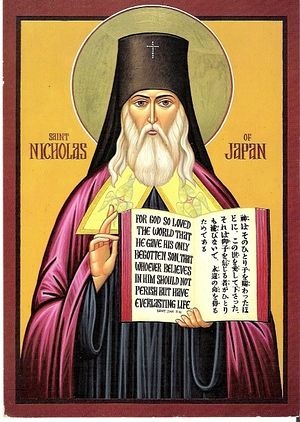
Kontakion 5
You appeared as a divinely-moving star of God, O father, zealously serving the Sun of Justice and guiding the faithful to the Lord like the star of Bethlehem in the old days. Clothed in the Light you bore, we cry to Christ:
Alleluia!
Ekos 5
Seeing pagan shrines and Buddhist pagodas, the righteous one wept and prayed: “Where shall I build a Church for Thee, O Lord?”, and the prayer of his heart was heard.
Rejoice, as the deer on the water brooks!
Rejoice, you who erected the temple of Resurrection of Christ!
Rejoice, you who reared the Cross above the capital city!
Rejoice, you who made the bells toll to Heaven!
Rejoice, you who extinguished the fire of Christian persecutions!
Rejoice, you who acquired a good name among the Japanese people!
Rejoice, you who did not offend the ancient customs!
Rejoice, you who became a friend and a brother of the Japanese nation!
Rejoice, God-sent bearer of the Light!
Rejoice, faithful steward of the Lord!
Rejoice, now crowned with heavenly glory!
Rejoice, O Nicholas, equal to the apostles, defender of the Church of Japan!
Kontakion 6
Preachers of the Holy Gospel rejoice in their heavenly abodes, greeting you as their fellow. And we, your earthly family, beholding such grace, sing to God:
Alleluia!
Ekos 6
Having first shined in the land of Smolensk, you now join All Saints of the Russian land: behold Saint Demetrius of Rostov, a melodious flute of the Spirit; behold Saint Tikhon, the pride of Zadonsk, a gatherer of the treasures of wisdom; behold Saint Stephen, the enlightener of Perm; behold Saint Sergius, Zosimus, and Sabbatius of the Solovki, a consolation of Russia,; behold all the Saints, both hidden and disclosed, the Divine Light of your fatherland. And we, full of great joy, praise the new Saint:
Rejoice, son of a country deacon!
Rejoice, you who had known indigence from childhood!
Rejoice, you who made the vow of poverty!
Rejoice, you who kept your monastic vows till death!
Rejoice, bishop who many times mended vestments!
Rejoice, you who dwelled in humble huts!
Rejoice, you who never sought worldly things in the world!
Rejoice, guide of the new converts!
Rejoice, baptizer of the Ainu fishermen!
Rejoice, you who reached the utmost lands!
Rejoice, you who reared fellow champions in your school!
Rejoice, O Nicholas, equal to the apostles, defender of the Church of Japan!
Kontakion 7
Preparing to depart from earth into heaven, the blessed one said: “What do I need this body for, tormented by illnesses, if I cannot labour for the Lord? I leave this bodily temple, crying:
Alleluia!”
Ekos 7
There was a new feast in the capital city of Japan: the Saint celebrated Easter at the cathedral in Tokyo, and the Japanese people got to know the true Pascha of salvation. And we, remembering that day, cry loudly:
Rejoice, you who preserved love in a cruel epoch!
Rejoice, governor of the feast of the Church!
Rejoice, elder of unslumbering eyes!
Rejoice, father, greeting your children with a kiss!
Rejoice, you who set forth your children before the Lord!
Rejoice, you who won the grace of the Spirit by daily labours!
Rejoice, you who saw the fruits of your efforts at your departure!
Rejoice, you who threw a mustard seed into the earth!
Rejoice, you who left us a beautiful tree!
Rejoice, living bridge of the Christian world!
Rejoice with angelic joy at the day of your Lord’s Resurrection!
Rejoice, O Nicholas, equal to the apostles, defender of the Church of Japan!

Kontakion 8
Beholding a strange wonder, as Japanese children of Christ served Russian war prisoners as their brothers, we sing a song to the Lord:
Alleluia!
Ekos 8
You gave yourself over to the service of God, and also served people incessantly, combining both commandments. Admiring your royal road, we praise you thus:
Rejoice, wise servant of God!
Rejoice, you who offered the priestly sacrifices for the nations!
Rejoice, protector of Russian war prisoners!
Rejoice, you who did not abandon your children in the war storm!
Rejoice, you who remained loyal to your native country!
Rejoice, teacher of mercy and courage!
Rejoice, you who led tempted souls to chastity!
Rejoice, refuge of the outcast!
Rejoice, treasure of humbleness!
Rejoice, abode of repentance!
Rejoice, love invincible!
Rejoice, O Nicholas, equal to the apostles, defender of the Church of Japan!
Kontakion 9
Every tree is known by its fruit, and your great labour bore the fruit of salvation for many people. Therefore we cry:
Alleluia!
Ekos 9
Most eloquent orators are amazed at your deeds, angels rejoice with you. And we, beholding your humble life and mighty patience, praise you thus:
Rejoice, you who laboured zealously not in ancient times, but in our days!
Rejoice, worthy image of an Orthodox archpastor!
Rejoice, profound exposure of our sins!
Rejoice, sinless confession of Christ!
Rejoice, true measure of prudence!
Rejoice, treasure gathered in the Spirit!
Rejoice, treasure spent for one’s neighbours!
Rejoice, you who are repaid a thousandfold!
Rejoice, full of immortal joy!
Rejoice, you who appease our agonies!
Rejoice, you who accept our prayers with fatherly love!
Rejoice, O Nicholas, equal to the apostles, defender of the Church of Japan!
Kontakion 10
You set out to save desperate people, ignorant of the One True God. Now your children, who saw great light in the region and shadow of death, cry to the Lord:
Alleluia!
Ekos 10
“Thou art our bulwark, O Holy Virgin!”, prayed the Saint fervently amidst his labours, establishing the Church. It stood unshielded among the Gentiles, as on a storm-swept island. And we, beholding its fortitude and fidelity, cry to you thus:
Rejoice, you who shielded your Church with secure protection!
Rejoice, you who committed the converts to the Virgin Mother of God!
Rejoice, you who taught maidens to pray!
Rejoice, you who led them to the light of chastity!
Rejoice, you who blessed Japanese families and consecrated their marriage bonds!
Rejoice, holy mirror of true judgments!
Rejoice, you who brought peace to villages and cities!
Rejoice, you who found strength in faith amidst troubles!
Rejoice, you who supported your elderly father until his death!
Rejoice, you who lived in the world, but remained free from the world!
Rejoice, you who were mourned by all at your decease!
Rejoice, O Nicholas, equal to the apostles, defender of the Church of Japan!
Kontakion 11
Every hymn is defeated that tries to encompass your apostolic service, O Saint, and together with you we say:
Alleluia!
Ekos 11
The Church of Japan received the light of good tidings in its native tongue, owing that to your labour, O true enlightener. You followed in the footsteps of the Ecumenical Teachers, using your wisdom-loving mind to serve the heavenly wisdom. Revering your good deeds, we praise you thus:
Rejoice, you who cognized the Holy Scripture!
Rejoice, you who passed it on to the children of men!
Rejoice, you who found the worthy words!
Rejoice, you who rejected the wrong and false ones!
Rejoice, you who perceived your efforts as a common work of the Church!
Rejoice, you who peacefully reposed from your labours!
Rejoice, you who brought the Word close to the people!
Rejoice, you who gave the Japanese Church the Divine Worship in its native tongue!
Rejoice, you who discarded every sophistication!
Rejoice, you who nourished your children with milk and honey!
Rejoice, you who humbled the pride of the hypocrites!
Rejoice, O Nicholas, equal to the apostles, defender of the Church of Japan!
Kontakion 12
The grace abided in you, revealing the holiness of your service. Even though you never performed miracles, just as St. John the Baptist never did, your all-surpassing evidence is the new Church, established by the miraculous power of God in our days. Together with it we sing with one heart:
Alleluia!
Ekos 12
Singing your glorification, as your name is included among the Saints, O brother and pastor, we praise you thus:
Rejoice, you who established the Church in our days by your holiness!
Rejoice, relief from earthly sorrows!
Rejoice, gentle blowing of the grace!
Rejoice, helper of those who fled unto you!
Rejoice, co-partaker of spiritual labourers!
Rejoice, good gardener and flower-keeper!
Rejoice, you who remedy our discords!
Rejoice, you who meet your children in the heavenly abodes!
Rejoice, you who commemorate those who commemorate you!
Rejoice, calmer of the stormy seas!
Rejoice, star of the Occident and the Orient!
Rejoice, O Nicholas, equal to the apostles, defender of the Church of Japan!
Kontakion 13
O most holy and most wonderful, most glorious and most marvellous enlightener of the land of Japan, constantly praying for us before the throne of the Holy Trinity, Saint Father Nicholas, equal to the apostles! Accept our present offering and entreat our God the Saviour and His Holy Virgin Mother that through your intercession He may illuminate with the light of Orthodoxy the nations you enlightened and our own country, and that He may deliver us from every assault of our enemies visible and invisible, from bane and temptations, misfortunes and distresses, and grant us forgiveness of sins and deliverance from the eternal death, and make us worthy of the Kingdom of Heaven, that together with you and all the Saints we may sing to the Holy Trinity unto ages of ages:
Alleluia!

Prayer
O all-praised Mother Who didst lead Saint Nicholas, equal to the apostles, to the remote land of Japan to preach the Word of Thy beloved Son! Behold, Our Lady, he executed Thy will. Stretch Thy blessing hand towards Thy servants, children of those whom he converted, and towards us, abiding in our sins, that through his prayers we may preserve the Orthodox faith unto the ages of ages. Amen.
Source